Centralising the UX Team at MHR
Overview
As the Senior UX Designer and acting Head of UX, I led the transition from a distributed UX model to a more centralised operating model across People First and iTrent. The goal was to improve consistency, accessibility, governance, and team effectiveness, while creating clearer engagement points between UX, Product, and Engineering. This work helped reposition UX from a reactive delivery function to a more strategic partner in planning, prioritisation, and product decision making.
This case study outlines the problem, approach, change journey, and impact, with a focus on leadership, organisational design, and delivery outcomes.
Role
Senior UX Designer (Acting Head of UX)
Year
2025
Context
Domains: HR, Workforce Management, Payroll and Finance Software
Team: 5 Senior UX Designers, 4 UX Designers,
Products: People First & iTrent
At the time, UX designers were embedded within individual product teams, operating with varying processes, standards, and levels of influence.
The Problem
The distributed model created several challenges:
Inconsistent UX quality across the product.
Duplication of effort across similar features and components (e.g. approval journeys across expenses, holidays & transfers)
Limited knowledge sharing between designers
Inconsistent accessibility standards and governance
Unclear ownership between UX, Product, and Engineering
Designers felt isolated, reactive, and overly delivery focused
From a leadership perspective, it was difficult to:
Balance workload and prioritisation
Maintain design standards
Support progression and development
Align UX work to broader business and product strategy
Success Criteria
The centralisation initiative aimed to create one aligned UX function with shared standards and practices, improve consistency and quality across HR products, embed accessibility as a core standard rather than an afterthought, increase UX influence earlier in product discovery and planning, enable better resourcing and prioritisation across initiatives, and build a stronger UX culture and community.
Success would be measured through improved stakeholder confidence in UX, reduced duplication of work, clearer ownership and ways of working, positive designer feedback and engagement, and better alignment to quarterly product plans and OKRs.
My approach
I approached this as both a change management and UX strategy challenge.
Diagnosis & Insight
I started by:
Reviewing current team structures and delivery models
Identifying overlap across product areas
Listening to designer concerns and frustrations
Gathering feedback from Product Managers, Engineering Leads, QA, and Delivery managers.
This highlighted the need for clearer boundaries, stronger governance, and shared standards.
Designing the Centralised Model
Working closely with the Head of Product and Product Managers, I helped define:
A central UX team structure aligned to strategic priorities
Clear roles and responsibilities across UX, Product, and Engineering
Ownership models for:
Design systems
Accessibility
Research and insight
Quality assurance and sign-off
Designers would still support product teams, but through planned allocation, not permanent embedding.
Process & Ways of Working
To make centralisation work in practice, I introduced:
Shared intake and prioritisation with Product leadership
Clear UX engagement points across discovery, delivery, and release
Agreed expectations around:
Design involvement in refinement
Accessibility checks
Smoke testing before release
I also worked with Engineering and QA to ensure UX tasks and checks were visible and accountable within delivery workflows.
Communication & Change Enablement
Centralisation can be disruptive, so communication was critical.
Co-created and presented the new model to the UX team with the Principal designers
Led sessions explaining why the change was happening, not just what was changing
Ran follow-up workshops to gather feedback and address concerns
Presented the approach to Product & Engineering leadership to gain alignment
This helped shift perception of UX from a service function to a strategic partner.
Challenges
Navigating resistance, building confidence, and embedding quality through change.
Shifting mindset and operating model
A major challenge in centralising the UX function was shifting both mindset and operating model. Many teams were used to having a dedicated designer embedded in their area, so moving to a more flexible, priority-led model naturally created resistance and concern around access, ownership, and speed.
Managing internal change while maintaining delivery
Internally, the change also brought uncertainty for the UX team, as designers had to adapt to new expectations, new ways of allocating work, and a stronger focus on business priorities over stream based familiarity. Alongside that, I had to manage the tension between maintaining short term delivery momentum and putting the longer term structure, governance, and ways of working in place that would make the team more effective over time.
Embedding quality, clarity, and alignment
Another key challenge was ensuring that accessibility, design quality, and proper UX process were not seen as slowing teams down, but as practical enablers that reduced risk, improved clarity, and led to better outcomes for users and the business. I addressed this by being transparent about why the change was happening, engaging closely with Product Heads, Product Managers, and senior stakeholders, iterating the model based on feedback, and clearly defining how UX would work with Product and Engineering. Through regular communication, process documentation, and visible leadership, I helped create greater alignment, reduce ambiguity, and build confidence in a more centralised UX function that could support both People First and iTrent more strategically.
VALIDATING THE MODEL
To make sure the centralised UX model was not just implemented, but working effectively in practice, I ran structured feedback loops with both Product Managers and UX Designers. This gave me a balanced view of the model from both sides: how it felt for stakeholders engaging with UX, and how it felt for the team delivering within it.
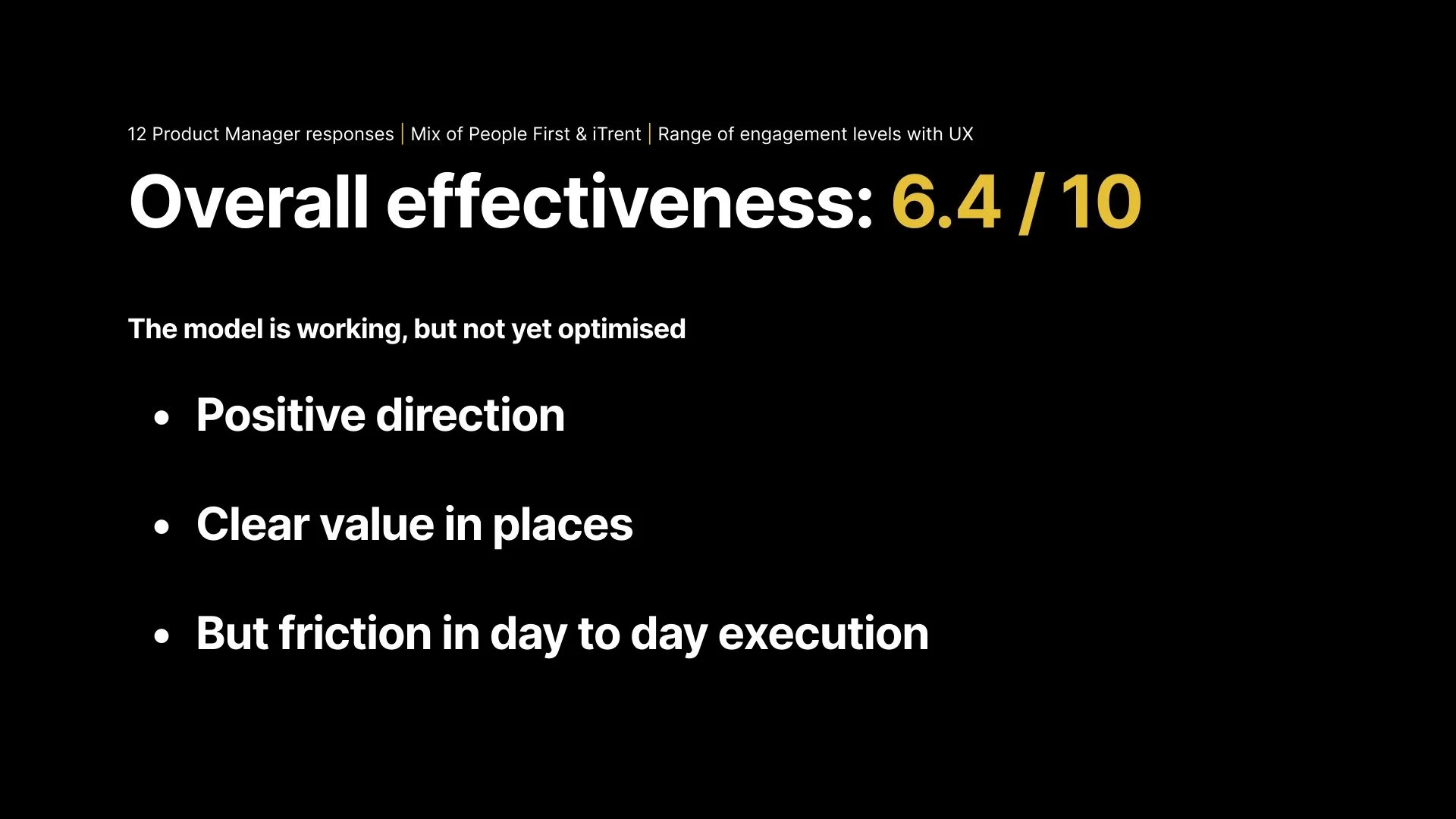
PRODUCT MANAGER PERSPECTIVE
The overall direction was seen positively, with the model viewed as working but not yet fully optimised.
Strongest feedback centred on UX communication, design rationale, and handover quality.
The biggest friction points were around when to engage UX, the visibility of active work, and understanding the different types of UX support available.
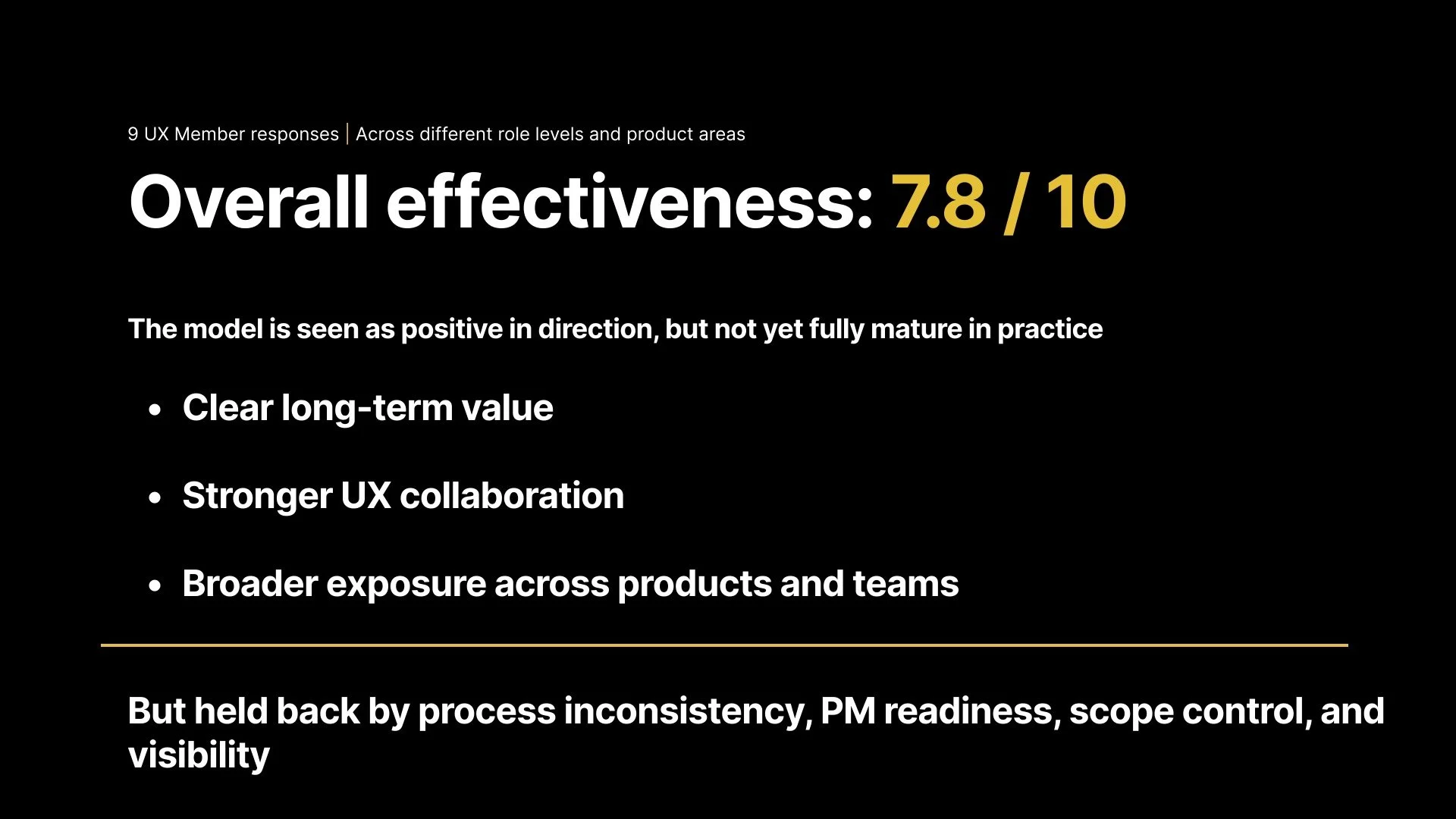
UX TEAM PERSPECTIVE
Designers felt more connected as a team, with stronger collaboration, shared support, and broader product exposure.
The model helped reduce siloing and improved visibility across the wider UX function.
The biggest challenges were briefing quality, scope control, workload visibility, and maintaining connection with feature teams through delivery.
Rather than treating the feedback as a challenge to the direction, I used it to mature the model. I introduced a shared Teams Planner Kanban to improve visibility of active design work, ownership, timelines, and priorities across Product and UX. I also began shaping a more structured briefing and CURB based intake approach to improve the quality, readiness, and triage of work entering the team. This helped move the model from structural change into operational maturity.